
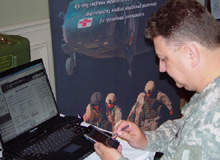
As an army medic deployed in Iraq, Sergeant Styles Bernard recalls clearly the problems paper medical records caused when treating patients from the battlefields. Records lost in transit, corrupted by the weather or body fluids and records simply illegible to the trained eyes of the medical staff trying to read them.
As soldiers are moved from training, to deployment, from aid stations to hospitalisation, all sorts of potential problems arise with the paper system but to ensure continuity of care, it is vital each stage of a military patient’s treatment is captured, stored and available at the next stop on their road to recovery.
Go deeper with GlobalData


Discover B2B Marketing That Performs
Combine business intelligence and editorial excellence to reach engaged professionals across 36 leading media platforms.
So what are the successful components of an electronic health system for the defence industry and how can we ensure it is used effectively?
MC4 – MEDICAL INFORMATION MANAGEMENT
In the United States the Medical Communications for Combat Casualty Care (MC4) integrates, fields and supports a medical information management system for the army’s medical forces.
It has captured around five million electronic health records to date and has sent more than 24,000 systems to the battlefield in support of Operation Enduring Freedom, the United States military operations in Iraq.
According to Lieutenant Colonel Edward Clayson, MC4 commander and product manager, MC4 enables, ‘secure, accessible electronic medical records for all service members – ensuring a continuum of care from the battlefield to home’. He believes making the system successful comes down to one thing – people.
“By fielding a system without proper training and support, users won’t welcome the change in documenting from paper to computer,” he explains.
“They’ll also be more likely to revert back to using paper forms when they encounter a problem with the system and don’t have an immediate solution on hand.”
DMICP – DEFENCE MEDICAL INTEGRATED HEALTH RECORD
The United Kingdom rolled-out its own information management system called DMICP (Defence Medical Information Capability Programme), in February 2007.
Aimed at providing an integrated health record (iHR) for armed forces and their families, it allows records to be accessed across the UK, overseas and on the battlefield.
By 2010 it is hoped the system will link electronically with the National Health Service.
The system currently looks after a population of approximately 200,000 service personnel, 50,000 civilians and manages around 500 fixed sites across the UK and worldwide.
A deployed version of the system is being developed with defence medical services experts and once completed will be available in field hospitals, on ships and on the battlefield via laptops and other portable equipment.
TRAINING ISSUES
Although it has been reported that army personnel say a lack of full training has prevented the full utilisation of these electronic health systems, MC4 can confirm that it has trained more than 26,000 medical professionals to date.
Although only contracted to provide an initial training, Lieutenant Clayson stresses that MC4 takes on a more comprehensive role with training because ultimately, ‘the user’s success is our success’.
MC4 training is multi-pronged including pre- and post-deployment classroom training, unit training at exercises and mobilisation sites and unit and individual training at a staging area in Kuwait. Online and CD training tools are also available.
Although the medical industry has a common goal of centralised electronic health records, military requirements are far more demanding and technically more complicated to deliver.
There is no doubt that electronic data is likely to be safer to store, easier to read and easier to use than paper but the challenge arises in developing a system that is portable, easily utilised, fully functional, quick and accessible in emergency frontline situations.
FUTURE BATTLEFIELD ELECTRONIC PATIENT DATA HANDLING
Sergeant David Pritt, medic, Health Services Command 479th Engineering Battalion says from the point of injury to evacuation there is little time to document patient care.
If you do get the chance you are, ‘placing it on a field medical card to be forwarded with the patient, or at minimum on a 3in strip taped to them’.
The ‘personal information carrier’, invented by Physical Optics Corporation will help with this type of problem in the future. A dog tag-sized wireless personal information carrier system, it allows patient data to be accessed wirelessly and has the ability to store up to 4GB of memory – around 20 years of medical records. It also allows for fast data transfer using Bluetooth technology.
Through the continued development of centralised, electronic patient data systems that allow mobile and portable systems to capture medical information quickly and accurately, it is clear defence IT has much to look forward to. It is essential, however, that equipment continues to advance and is utilised effectively, along with comprehensive training, which is an ongoing battle in itself.


